

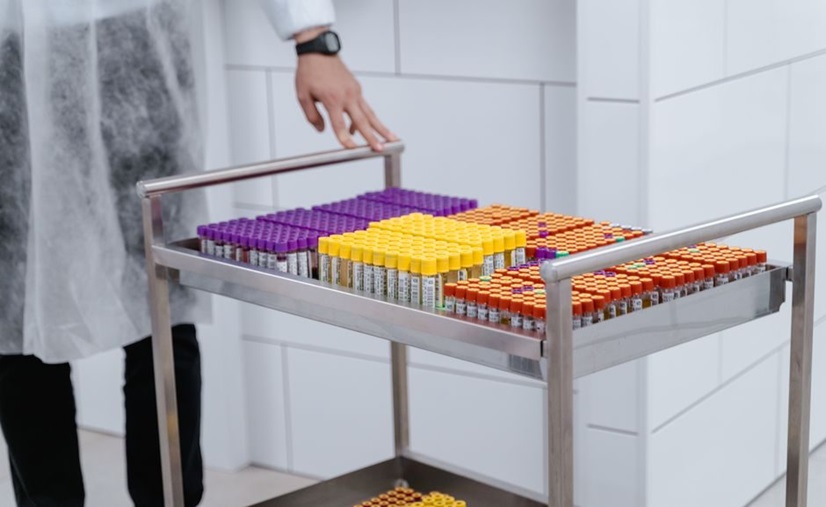
A lab freezer set to minus twenty degrees looks like the end of the story for a research peptide’s stability. It is not. Most of the damage that shows up later as a flat chromatogram or an unexpected shoulder peak happened earlier, somewhere between a courier van and a loading bay, long before the sample reached that freezer at all.
Key Takeaways
- Lyophilised peptides are removed from a solvent environment specifically to reduce degradation risk during transport and storage, not to make handling easier.
- Repeated warming and cooling during transit, not the final storage temperature alone, is a leading cause of measurable peptide degradation in laboratory settings.
- Documented temperature-controlled distribution, the same standard used across pharmaceutical cold chains generally, is what separates a sample a researcher can trust from one that needs re-verification before use.
- A gap in the paper trail between despatch and delivery is itself a data quality problem, even if the sample looks visually unchanged on arrival.
- Suppliers who publish batch-level testing alongside their storage and shipping practices give researchers a way to sanity-check a sample before it goes anywhere near an assay.
Peptide chemistry gives researchers a structural reason to worry about this. Peptide bonds are vulnerable to hydrolysis, oxidation and aggregation, and each of those pathways is accelerated by moisture, heat, and the mechanical stress of thawing and refreezing. None of that requires exotic conditions. Ordinary transit, sitting in a warm delivery vehicle for a few hours, is enough to start the clock.
Why Lyophilisation Exists in the First Place
Freeze-drying, or lyophilisation, removes water from a peptide preparation under vacuum, leaving a stable powder that sidesteps most of the hydrolytic degradation pathways an aqueous solution is exposed to. The UK’s National Institute for Biological Standards and Control notes that dry peptides can remain stable at room temperature for days to weeks, but recommends storage at minus twenty degrees Celsius or below for anything longer term, precisely because moisture ingress is the main threat once the powder is out of its sealed vial.
That framing matters because it shifts the real risk window. A lyophilised peptide sitting correctly sealed in a courier’s warehouse overnight is not automatically compromised. What compromises it is contact with humid air, condensation from a badly managed temperature swing, or a container that was never properly sealed after a previous opening.

A courier handing over a package and confirming a signed delivery
Temperature Excursions Are the Real Villain
A temperature excursion, moving outside the intended storage range for any stretch of time, is the standard term pharmaceutical logistics uses for exactly this failure mode. UK guidance on pharmaceutical cold chain distribution treats a temperature excursion as an event that can compromise product quality regardless of how brief it is, which is why the World Health Organization’s model guidance for storing and transporting temperature-sensitive products treats continuous monitoring, not just correct final storage, as the baseline requirement.
Excursions are also cumulative in a way that is easy to underestimate. A vial that experiences several short excursions across different legs of a journey, a warm loading bay here, a delayed handover there, can end up with a similar total thermal exposure to one longer single excursion, even though no individual leg looked concerning on its own. Distribution guidance that only checks the temperature at pickup and delivery, without a continuous record in between, cannot distinguish between those two scenarios.
A cold chain is only as reliable as its weakest single leg, and that leg is rarely the freezer.
The same principle applies at laboratory scale. A peptide that spends forty minutes in an unrefrigerated delivery van on a warm day, then goes straight into a minus-eighty freezer, has still been through a thermal event. Whether that event mattered depends on the specific peptide’s stability profile, but the point is that nobody can answer that question without knowing the excursion happened in the first place.

Warehouse aisle used for temperature-controlled distribution storage
What Documented Distribution Actually Buys a Researcher
UK pharmaceutical distribution operates under Good Distribution Practice, which requires documented, temperature-monitored transport for products where storage conditions affect quality. Research peptides fall outside formal GDP licensing, but the underlying logic still applies: a supplier who can show how a batch moved from manufacture to despatch, and under what conditions, is giving a researcher something a sealed box on its own cannot, a basis for trusting the sample rather than assuming it.
This is one of the reasons batch traceability and cold-chain documentation matter as much as the certificate of analysis itself. A pristine purity result from the manufacturer says nothing about what happened to the specific vial that arrived on a particular bench three weeks later. Peak Peptides, a UK-based research peptide supplier, publishes its handling and despatch practices for products such as Retatrutide 20mg alongside batch documentation, which gives researchers something concrete to check against rather than taking storage claims on trust.
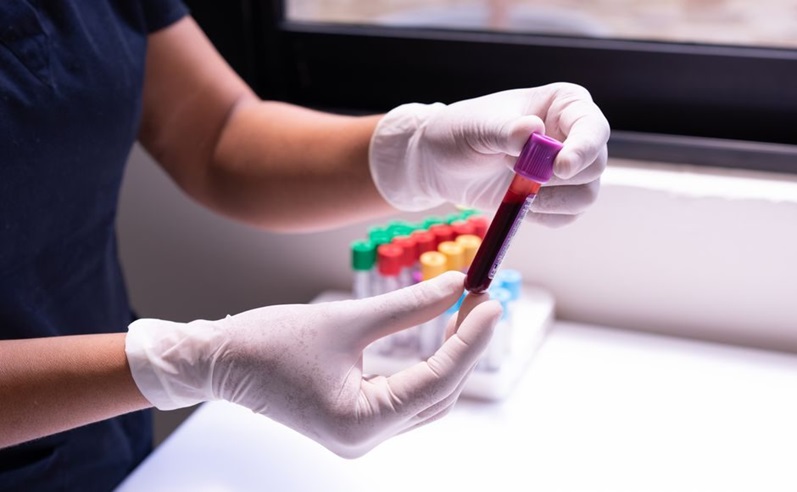
Scientist wearing gloves handling a sample vial in a laboratory
Building Cold Chain Awareness Into Ordinary Lab Practice
None of this requires expensive infrastructure for a small research group. It requires habits: checking a delivery arrived within the expected window, inspecting packaging for signs of a failed cold pack, logging the date and condition of receipt before a vial goes into storage, and treating any unexplained gap in that record as a reason to flag the sample rather than assume it is fine.
Labs that already log freeze-thaw cycles for their own aliquots, a widely recommended practice given how much repeated thermal cycling degrades peptide integrity, are well placed to extend the same discipline backward to the point of receipt. The habit is identical: write down what happened to the sample before it reaches the assay, not after something looks wrong.
A simple receipt checklist covers most of the practical ground. Note the time and date a delivery actually arrived against the window the courier quoted, check whether any cold pack included in the packaging still felt cold or had fully warmed, and record the ambient temperature of wherever the vial is placed before it reaches proper storage. None of these checks takes more than a minute, and together they turn an assumption about cold chain integrity into something a lab can actually stand behind if a result later needs explaining.
Frequently Asked Questions
Does a lyophilised peptide need refrigeration during short-distance transport?
Not necessarily for very short transit times, but any extended exposure to warm ambient conditions increases hydrolysis and moisture risk, so temperature-controlled shipping is the safer default whenever transit time is more than an hour or two.
How can a researcher tell if a temperature excursion happened during shipping?
Without a logged temperature record, the honest answer is that you often cannot tell from visual inspection alone, which is why documentation of the shipping conditions, not just the final storage temperature, is the more reliable signal.
Is a single freeze-thaw event during transit as damaging as one during lab storage?
The degradation mechanism is the same, thermal and mechanical stress on the peptide structure, but transit events are harder to detect because they happen outside the lab’s own monitored environment, which makes supplier-side documentation more important, not less.
Why does packaging quality matter as much as the stated storage temperature?
Because the packaging is what maintains that temperature in transit. A correctly rated cold pack in inadequate insulation can still allow a temperature excursion well before the stated hold time expires.
Should every batch come with its own certificate of analysis rather than a generic one?
Yes, in principle, because a generic certificate describes the compound’s expected properties, not what happened to that specific batch during manufacture, storage and shipping, which is the information a researcher actually needs to trust a sample.